At our 20 year old house, there was no UTP cabling and is almost impossible to install it., Quite a pitty. Solution was wireless and broadband over power line, with Netgear Powerline AV500.
But with COAX for TV in almost every room, installed MoCA adapters. And now very good and stable Internet connectivity.
SAP and Google have announced a partnership. First impression is that SAP will leverage the Google Cloud Platform as an underpinning for its
As Google has just acquired the API Management solution Apigee and SAP is an OEM customer of Apigee, what impact will this have on SAP's API Management offering?
And 2nd question: will SAP Cloud Integration also become available on Google's cloud platform?
While integrating with Salesforce, had an issue getting the authentication right. What is that cloud integration platform actually sending to Salesforce? How to get a look into the message on the wire?
Simple but efficient solution, pick one of the many free HTTP endpoints. Point to the temporary URL, send the message and get all the info on HTTP headers and payload. So trivial and easy.
Very interesting news in the press the last couple of days. The Salesforce system of the beverages company Diageo allows a large group of users to access data in back-end systems, including SAP ERP. Because of the named user license model of SAP, British court has ruled that a fee must be paid for each user of the Salesforce system. A little known aspect of integration: legal! Actually, the integration between Salesforce and the on-premise SAP and Oracle systems was handled by SAP PI.
Regularly I give public workshops on the topic of Application Integration in Belgium via SAI and in the Netherlands via AdeptEvents. A video interview about my workshop and the topic of application integration has just been released by AdeptEvents. Enjoy!
A few weeks ago, attended a big IBM training event about IBM's e-commerce offering. During the conference, a new brand name was released: "Watson Customer Engagement". My primary interest were the B2B integration solution of IBM, that are part of this suite and fall under the category "Watson Supply Chain".
IBM has an extensive range of products that are part of it's Watson Customer Engagement offering: obviously e-commerce or "Digital Commerce", but also Order Mangement, procurement, digital marketing, customer experience analytics and much more. There is even a specific product to have an overview of all available stock across all warehouses and stores.
Maybe not well known, but IBM also has a very extensive B2B integration network called the IBM B2B Collaboration Network.
Everyone of the IntegrationDesigners team (IBM integration team of the Cronos group) gets his turn to attend events and conferences. Already had the IBM cloud conference in Madrid in October 2016 and now this conference in Las Vegas, Nevada.
Trip to Las Vegas was quite a hell: snow on the road to Brussels airport, more than an hour wait in the plane before take-off in Brussels, very late arrival in New York because of snow, missed connecting flight, long queue to re-book to another flight, just-in-time to get on the last plane to Las Vegas, long wait in the plane to be de-iced, ... Such 28 hour trip is pretty tiring.
With the longer weekend (Friday Nov 11 is a public holiday in Belgium, to remember the end of WW I) took some time to watch some sessions from the Devoxx conference that has just finished. The talks are already available on Youtube! Great content: Microservices, Reactive, Netty, Kafka messaging, Docker, ... With this conference almost in my backyard, will have to free up some time next year to attend again myself.
One talk immediately drew my attention: "Effective Service API Design" by Elliott Rusty Harold. I know Elliott an XML guru. Remember being at the speaker's table with him at XML DevCon in London back in 2001 where I presented "Understanding SOAP".
Some thinks I picked up:
"Contract first" >> "Documentation first"
Start small (MVP Minimum Viable Product, YAGNE You Ain't Gonna Need It)
Leverage the URL, not everything
Prefer idempotency
Use standards: UTF-8, standard data/date formats, standard decimals with 2 digits
Avoid required data elements
Deprecation policy, how long to keep the old API, 2 year notice is good
Plan for versioning: easier without schema's but with optional fields
No assumption about use of client code/library, developers will often not use those
If you build client code/library, develop it by hand and do not generate it
Authentication and authorization remain a challenge
Performance!
Although a good talk, would have hoped for some more specific guidelines.
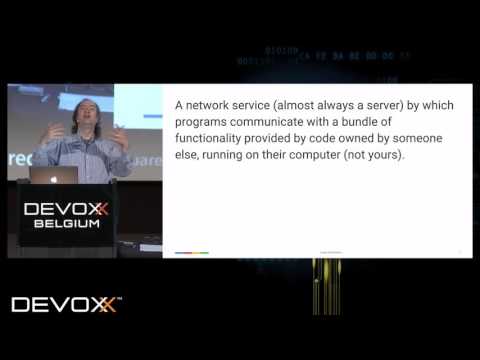
At the start of the presentation, Elliott clearly makes the difference between the local "library API" (e.g. the JDBC API with the java.sql package) and "Remote API" or "Service API". Great definition by the way: a network service (almost always a server) by which programs communicate with a bundle of funcitonality provided by code owned by somone else, running on their computer (not yours).
Thanks to the Devoxx team and Stephan Janssen to publish this great content for free!
 At our 20 year old house, there was no UTP cabling and is almost impossible to install it., Quite a pitty. Solution was wireless and broadband over power line, with Netgear Powerline AV500.